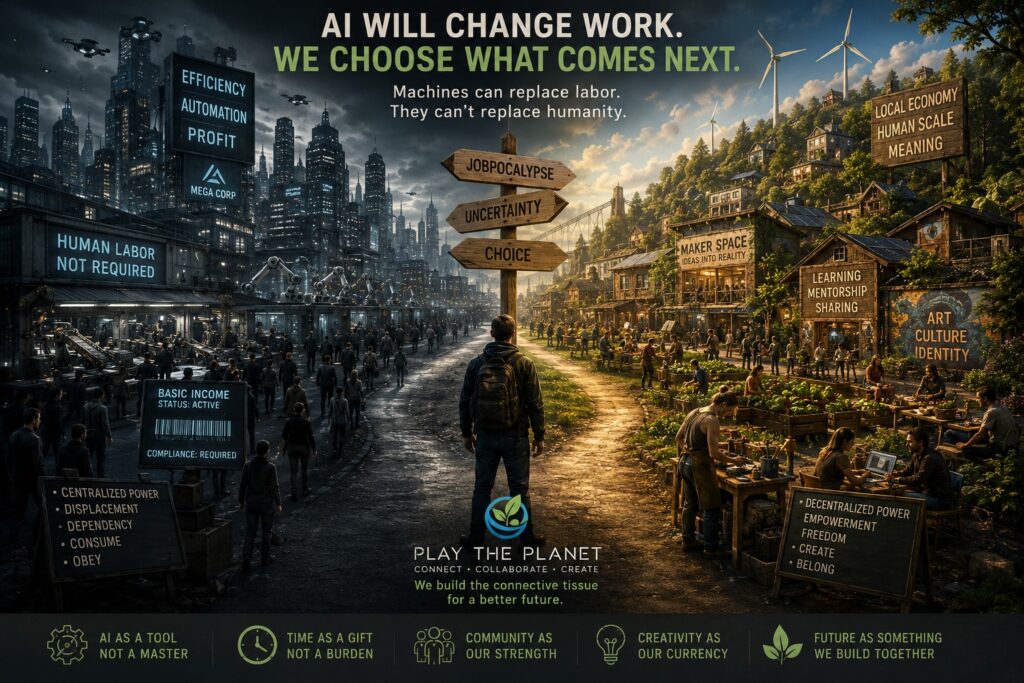
If you’ve been paying even a little attention to AI over the past few years, you’ve probably heard the same reassurance over and over again:
“AI won’t replace people.”
“AI will just augment workers.”
“Every technological revolution creates new jobs.”
Some of that is technically true.
Most of it is cope.
The reality is that AI and robotics are very likely to eliminate an enormous number of jobs over the next twenty years — not just factory jobs, but white collar jobs, creative jobs, technical jobs, logistics jobs, customer service jobs, transportation jobs, and eventually a significant portion of management itself.
Not because there’s a secret conspiracy.
Not because CEOs are cartoon villains sitting around a table twirling their mustaches.
Because the incentives point there naturally.
For centuries, labor has been one of the single largest expenses most businesses face. Wages. Insurance. Regulations. Time off. Sick leave. Training. HR. Liability. Scheduling. Turnover.
From a purely mechanical perspective, companies have always had an incentive to reduce dependence on human labor wherever possible.
AI and robotics are simply the latest, and potentially final expression of that pressure.
And unlike previous industrial revolutions, this one threatens cognitive labor too.
The Industrial Revolution replaced muscle.
This one replaces portions of thought itself.
That matters.
Because the old reassurance that “people will just move into new kinds of jobs” becomes a lot shakier when machines can increasingly perform both physical and intellectual tasks faster, cheaper, and at scale.
Eventually, we hit a dangerous contradiction:
Workers are also consumers.
Machines do not buy products.
Algorithms do not go shopping except on behalf of humans.
Robots do not care about your quarterly earnings report.
A fully automated economy sounds wonderful right up until you realize that mass production systems require mass consumption systems.
So what happens?
Most likely: governments intervene to preserve social stability.
Not out of kindness.
Out of necessity.
Whether people call it Universal Basic Income or something else, some form of baseline economic support becomes increasingly likely in heavily automated societies. Without it, you risk social collapse.
People tolerate inequality.
They do not tolerate permanent irrelevance.
Especially not in heavily armed Western societies with collapsing upward mobility.
Now, a lot of people hear “UBI” and imagine some kind of utopia.
I don’t.
UBI is not freedom.
It’s dependency.
It’s a gilded cage.
A system designed less to empower people than to preserve order in a world where fewer workers are economically necessary to large centralized systems.
And yet…
History is full of systems accidentally creating the conditions for their own transformation.
Because while UBI may preserve stability for governments and corporations, it may also produce something they are not actually optimizing for:
Time.
Time people no longer spend:
commuting,
working unpaid overtime,
answering emails at 9 PM,
or sacrificing their entire lives just to remain barely solvent.
At first, most people will waste that time.
Of course they will.
People will binge games.
Scroll endlessly.
Drown themselves in algorithmic entertainment.
Spend six months learning guitar and never touch it again.
But not everyone.
Some people will use that time to build.
And here’s where things get interesting.
For most of modern history, sophisticated organizational tools belonged almost exclusively to governments, militaries, and massive corporations.
That is no longer true.
AI is rapidly democratizing capability itself.
One person can now:
build software,
publish films,
design products,
manufacture prototypes,
run logistics,
coordinate communities,
market globally,
and access expertise that previously required entire departments.
That changes the equation dramatically.
Because the same AI systems corporations are using to reduce labor costs can also be used by ordinary people to build parallel systems outside traditional corporate structures.
And corporations have a weakness:
they are optimized for efficiency, not humanity.
Large systems are very good at scale.
They are terrible at meaning.
Terrible at local culture.
Terrible at trust.
Terrible at authenticity.
Terrible at human belonging.
That creates an opening.
As industrialized consumer culture becomes increasingly sterile, centralized, and machine-driven, people will begin rediscovering something older and more human:
local economies,
small communities,
craftsmanship,
identity,
shared culture,
mutual support,
and human-scale creation.
Not because everyone suddenly becomes enlightened.
Because increasingly automated systems will leave gaps.
And human beings are very good at filling gaps.
The future may not look like a traditional economy at all.
It may look more like thousands (eventually millions) of interconnected micro-economies:
artists,
makers,
educators,
community builders,
small manufacturers,
repair networks,
local agriculture,
distributed entertainment,
mutual aid systems,
digital guilds,
and hybrid physical/digital communities.
Some of those systems will fail.
Some will be absorbed by larger powers.
Some will become exploitative themselves.
But others will become resilient.
The mistake most futurists make is assuming the story ends at labor displacement.
It doesn’t.
Labor displacement is merely the destabilizing event.
The real question is:
what comes next?
That is the space Play the Planet is attempting to explore.
Not anti-technology.
Not anti-AI.
The opposite, in fact.
The goal is to leverage the very tools being used to centralize power and use them instead to strengthen local resilience, human connection, decentralized creativity, and parallel economies built around actual people rather than pure extraction efficiency.
Because if AI truly does create a Jobpocalypse, then humanity will face a choice.
We can become permanently dependent consumers in increasingly centralized systems.
Or we can use the strange historical moment created by automation to rebuild human-scale civilization on top of machine abundance.
Ironically, the same technologies that may finally free humanity from compulsory labor may also give us our first real opportunity in centuries to rediscover what human beings actually want to do when survival is no longer the only thing driving every waking hour of their lives.
That future is not guaranteed.
But for the first time in a very long time, it is at least imaginable.
Sources & Further Reading
This is an opinion essay, and we’d rather you check our premises than take our word for them. The projections below span optimistic and skeptical views — including the strongest published case against the “this time is different” argument. Links verified live on July 12, 2026.
- Goldman Sachs (2023): Generative AI could raise global GDP by 7% — the analysis behind the widely cited figure of ~300 million full-time jobs exposed to automation.
- McKinsey Global Institute: Jobs Lost, Jobs Gained — scenario modeling of workforce transitions under automation.
- World Economic Forum: The Future of Jobs Report 2025 — employer-survey projections of job displacement and creation.
- Autor, “Why Are There Still So Many Jobs?” (Journal of Economic Perspectives, 2015) — the strongest case that automation complements labor more than it replaces it. If our thesis is wrong, this is roughly why.